Blog

Digital Economy, Digital Labour

The Role of Digital Jobs in Solving Youth Unemployment in Kenya

iHub Research in 2014 published a report on Digital Jobs in Kenya. Fast forward to 2018 how far are we? A key insight presented in the report was that there existed a digital skills gap between theoretical skills, attained by youth through various programs, and practical skills, sought after by employers despite the existence of the key trends of: online work, big data analytics, and the mobile applications sector which present great potential for large-scale digital job creation in the future.

February 2018, unemployment is hitting record highs of 39.1% in Kenya, based on a report by the United Nations Human Development Index (HDI) 2017 and in its midst there’s been concerted efforts towards encouraging entrepreneurship, it’s clear that we need to innovate around solving the problem of unemployment.

In December 2016 the government of Kenya launched the online jobs portal, Ajira in a bid to take advantage of ICTs in eradicating unemployment; specifically targeting the youth, with the promise that it would equip 1 million Kenyans with digital skills so that they can secure employment. Ajira’s tag line which states “Online WORK is WORK” aims to raise the profile of online work, promote a mentorship and collaborative learning approach to finding online work, provide Kenyans with access to online work and finally to promote Kenya as a destination for online work.

Since its launch we’ve barely heard of progress, statistics or testimonies of the users of the platform. We do know that together with Kenya Private Sector Alliance, the Ministry of ICT as a result of funding from the Rockefeller Foundation are implementing the first phase of the Ajira mentorship program, to train and mentor future young online workers. Will this be the reason Ajira and the concept of digital work will successfully scale in Kenya?

The concept of digital work is definitely not one that is new in Kenya and definitely not across the world, from where we can learn great lessons. Already existing in Kenya is the platform KuHustle that has 32,000 plus online workers, with over 1,000 jobs posted worth over US$920,000.

In order to adequately take advantage of this opportunity it is paramount to address the barriers affecting the job market as a whole in Kenya and creating mechanisms to overcome these barriers. Based on estimates from the government before the launch of Ajira in 2016, it was assumed that there were already 40,000 Kenyans working online and as adoption of technology and the Internet is gradually increasing in the country, this number has most definitely increased and has the potential to continue to do so, with time.

Digital job platforms serve the purpose of easing the process of connecting employers to a competitive selection of employees from different locations, background and privilege so long as they have an internet connection. Meanwhile it seems in this central narrative that technology in the form of digital jobs will be the salve of solving youth unemployment. How true is this assessment?

There is no doubt that digital jobs will definitely enable and increase the possibility of a greater percentage of the young population in Kenya (who are possibly marginalised due to issues surrounding lack of access) to acquire formal employment at higher wages than they would have previously probably acquired. Beyond the basic digital skill gap that is being addressed through training and mentorship by government initiatives, there exists huge demand for specialised skills, such as developers, data scientists, which the current supply levels fail to meet and this is an example of some of the fundamental barriers affecting the job market in Kenya, that need to be addressed while also focusing on digital jobs.

By utilising this multi-stakeholder and multi-dimensional perspective in analysing the challenges currently being faced in the job market in Kenya today, this approach will propel us closer to solving the issue of youth unemployment.


Digital Labour

Be Mindful of the Short-Circuiting of Platform Work Narratives

The fight for fair and decent digital work involves multiple fronts. These include advocacy for accountable applications of technology, an inclusive policy-making agenda, and the construction of alternative narratives to those favored by companies or neoliberal governments or both, to list a few. The fight for fair and decent digital work is also deeply affected by local and national contextual factors such as the existing labor market and local income level. All seem to be uphill battles calling for joint efforts from concerned scholars, activists, and workers.

The latest globally uneven proliferations of platform-dependent jobs (e.g., gig driving and micro-work) raise serious challenges in terms of how to localize the multi-front battle for fair and decent digital work. For developing countries in particular, which often concern themselves with integrating into the global (digital) economy and development agenda, the discursive front of the fight for fair and decent digital work—that is, mainstreaming the worker-centered narratives about platform work—turns out to be tougher than other fronts.

Scholars like to use the trope of the “black box” (Pasquale, 2015) to describe the secretive and opaque way in which private IT companies utilize proprietary algorithms to manipulate consumers, users, and workers. Though scholars may perform reverse engineering to gather information on the inner workings of certain algorithms, systematic knowledge is hard to acquire. For example, the secrets of Uber’s surge pricing algorithm were revealed in 2015. However, the surge pricing algorithm does not function in isolation in shaping drivers’ working experience with the ride-hailing apps, while Uber may change how the algorithm works at its will. Thanks to the work of many scholars (see, for example, Rosenblat & Stark, 2016), the informational asymmetry between companies on the one hand and consumers, users, and workers on the other has been recognized as a structural feature of the power dynamics among workers, the platform company, and the regulatory authority.

Besides opaque algorithms operating in the dark, I have become aware of the back-channel circulation of narratives about digital platforms and jobs (workers) directly from private companies to governmental official reports without engaging with third-party institutions or scholars’ voices, not to mention the inclusion of workers’ perspectives. I call this phenomenon the “short-circuiting of platform (work) narratives.”

Platform companies have the tendency to brand themselves as pioneers in offering technological solutions to social problems, and the leading Chinese ride-hailing company Didi Chuxing is no exception. It builds its platform work narratives around creating jobs and increasing income. Didi claims that the company created 17 million flexible jobs in 2016 and more than 21 million drivers earned their income on the platform from June 2016 to June 2017 (Didi, 2016; Didi Institute of Policy Study, 2017). Taxi drivers do not belong to the category of “new jobs,” despite the fact that a great majority of taxi drivers in China also work on the Didi platform (Chen, 2017a). The two reports highlight the company’s contributions to jobs-creation particularly in regions and sectors where China’s national development strategy for economic restructuring has brought about staggering figures of unemployment. These regions include the heavy-industrial sectors of the rust-belt provinces in northeastern China Take the 2016 report as an example; other than the vague number of 17 million and 5 million job opportunities for laid-off factory workers, the report revealed few details on specific work conditions or if the income earned through the platform accounted for living wages. The China Internet Network Information Center (CNNIC)—China’s authoritative agency on statistics about Internet use—cited Didi’s jobs-creation number (17 million) word for word in its annual report on China’s state of platform economy (CNNIC & Internet Society of China Sharing Economy Committee, 2017). In the absence of other figures or reports on drivers’ work conditions, CNNIC echoed the rhetoric of jobs creation and did not delve into the challenges facing drivers in the ride-hailing platforms.

China is hardly alone in the short-circuiting of platform narratives. This process is dangerous because it allows the language and figures of jobs creation, and more importantly, the framing of the platform’s contributing role in the economy, to travel in a narrative package from the private company to the governmental report. But the governmental report also serves as the reference for scholars and policy-makers. Without incorporating alternative perspectives and narratives on the relationship between platform technologies and workers and development, the governmental report may be at risk of losing its public accountability, which further prevents counter-narratives from surfacing into the mainstream conversations on how accomplish the goal of fair and decent digital work.

Works Cited

Chen, J. Y. (2017a). Technologies of control, communication, and calculation: taxi driver’s labor in the platform economy. In P. Moore, M. Upchurch, & X. Whittaker (Eds.), Humans and machines at work: monitoring, surveillance and automation in contemporary capitalism (pp. 231–255). London: Palgrave Macmillan.

CNNIC & Internet Society of China Sharing Economy Committee. (2017). Report on the Development of the Sharing Economy in China. Beijing.

Didi. (2016). Job Creation – VALUES. Retrieved September 5, 2017, from http://www.didichuxing.com/en/values/job-creation

Didi Institute of Policy Study. (2017). New Economy, New Jobs: 2017 Research Report on jobs on Didi Chuxing. Beijing, China: Didi Institute of Policy Study.

Pasquale, F. A. (2015). The Black Box Society: The Secret Algorithms That Control Money and Information. Cambridge: Harvard University Press.

Rosenblat, A., & Stark, L. (2016). Algorithmic Labor and Information Asymmetries: A Case Study of Uber’s Drivers. International Journal of Communication, 10, 3758–3784.


Digital Labour

Why Digital Geography Matters to Digital Workers

One_Big_Union_02

New forms of digital work have emerged which, in theory, can be done from anywhere. Does this mean that geography no longer matters to digital work? Not exactly.

My new chapter with Amir Anwar draws on our empirical research into digital labor to outline how geography still matters, and who it matters for in a world of increasingly digital work. The contemporary geography of digital labor can be used to exploit workers, but we also argue that it opens up distinct possibilities for digital workers to recreate their own worlds of work.

You can access a pre-publication version of the chapter below as well as a few paragraphs from the conclusions.

Graham, M. and Anwar, M.A. 2018. “Digital Labour” In: Digital Geographies Ash, J., Kitchin, R. and Leszczynski, A. (eds.). Sage. London.

Conclusions

The networking of the world has not rendered geography irrelevant – far from it. Clients now have access to a globally-dispersed pool of workers tethered to their homes because labor-power does still have to go home every night. This state of affairs presents a worrying and precarious situation for digital workers. In this chapter, we have argued that a spatial division of labor has been constructed in which digital labor is traded as a commodity at a global scale by placing workers into competition with one another in way that undermines the power of workers.

However, the geographic landscapes of digital labor that we see are not an inevitable outcome of the spread of digital technologies to every corner of the world. This chapter also argues that possibilities exist for what Herod (2001) refers to as ‘labor geographies’: spatial fixes created by and for workers that challenge the idea that atomized competition is an inevitability. Two very different ontologies – ‘digitally distinct space’ and ‘digitally augmented space’ – can be used to build those strategies.

This is not just an argument about semantics. Workers, unions, and regulators are all using outdated concepts to try and make sense of a contemporary world of work. If we are to build a fairer world of work, we are going to need new language and new concepts for networks, processes and organisations of digital labor, for strikes, for picket lines, and for coalitions of, and collaborations between, workers. These concepts will shape how we understand digital labor and how we envision ‘paths to the possible.’

Strategically deploying those spatial ontologies reveals sites at which the proactive geographical praxis of workers can reshape the geographies of labor. Workers do not necessarily need global campaigns to match the global reach of platforms and clients – instead, they need to understand the nodes at which the local can influence the non-local. Workers carry the power to dismiss the idea that digital labor represents a final hegemonic spatial fix in which they have no agency due to atomization and the commodification of work. Reconceptualizing the geographies of digital labor and digital labor geographies reveals remaining possibilities for collective action, for labor’s own spatial fixes, and for a reshaping of the very landscapes of digital work.

Digital Economy, Digital Enterprise

Enter Digital Enterprises in Africa

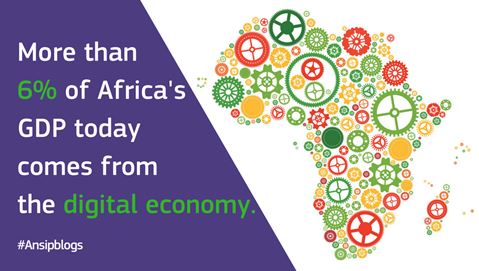
Digital technologies like Internet applications and mobile phones are changing the nature of work, business and organisations. Their extensive embeddedness in the economic exchange of goods and services is also creating digital economies – a phenomenon with growing importance. The digital economy is “that part of economic output derived solely or primarily from digital technologies with a business model based on digital goods or services”. For the global South in particular, the digital economy even though usually only accounting for 3 percent to 4 percent of gross domestic product (GDP), has a much larger impact when firms use it to spur competition and productivity in traditional sectors, such as retail, banking, and manufacturing. Available statistics suggest that the mobile ecosystem alone contributed US$8.3 billion to the Nigerian economy and 7% of Mali’s GDP consists of its digital industry (da Silva, 2014). Despite these successes, the region is yet to catch up with the bigger benefits the global North enjoys from the digital economy.

Synthesising Available Evidence
To have a deeper understanding of the digital economy in the global South (specifically Africa), available evidence was gathered and synthesised as part of DIODE Network activities. Unfortunately, the synthesis had to rely mostly on practice-based literature due to the scarcity of academic research on the digital economy of Africa. Such a synthesis was also important to uncover areas that need further research. Guided by the narrow definition of the digital economy, the synthesis focused on the activities of enterprises in telecommunications, digital services, software and IT consulting, hardware manufacture, information services, platform economy, gig economy, and sharing economy. Available evidence suggests countries like South Africa, Nigeria, Kenya and Ghana are quite advanced in the digital economy. Their advancement reflects their level of development and abounding availability of digital enterprise activities. Encouragingly, other countries with some investments from established players in the global North, are also making efforts to catch up.

Areas for New Research
Overall, five main themes emerged as areas that need new research efforts. First, there is need to undertake studies that trace value creation amongst various forms of digital enterprises. Second, there is need to study the career trajectories of people who engage in the various aspects of digital enterprises – especially the gig economy; in order to understand the factors determining their involvement. Third, there is need to undertake periodic and regular research to find out the motivations of the companies that want digital presence and mobile apps developed for them, and the development impact of their decisions on those who work on such requests especially if they are gig workers. Fourth, there is need to undertake country and cross-country case studies of the various platform and digital enterprise issues, to generate lessons and best practices for countries that are now picking up. Fifth, one big question that remains unanswered relates to knowing who exactly is benefiting from the digital economy in Africa, therefore it would be interesting to know the true beneficiaries, and also the coping mechanisms of the losers.

In summary, there is a paucity of academic research on digital enterprises in Africa. In order to end this paucity, more research needs to be conducted around this phenomenon in the global South. Such research could begin with the areas derived and discussed in this synthesis study.

Read More in the Synthesis Study here:

Boateng, R., Budu, J., Mbrokoh, A.S. Ansong, E., Boateng, S.L. & Anderson, A.B. (2017). Digital Enterprises in Africa: A Synthesis of Current Evidence, Paper 2. DIODE Network, University of Manchester.

Text Reference

da Silva, I. S. (2014). Mali Digital Plan 2020 to reorganise economy. Retrieved from http://www.biztechafrica.com/article/mali-digital-plan-2020-reorganise-economy/9327/

Picture Reference

Ansip, A. (2017). Heading to Nigeria, EU Commission and Its Priorities, Retrieved 23 November 2017 from https://ec.europa.eu/commission/commissioners/2014-2019/ansip/blog/heading-nigeria_en

Digital Economy

Impediments in Building the Digital Economy: Case of the National Optical Fibre Network Plan of India

Context

It is generally accepted that broadband plays a key role in the world, impacting the economy, productivity, employment and other spheres of society. The national governments in both developing and developed world are either contemplating or are already executing broadband access plans. India is no different. The Broadband Policy of India aims at enhancing quality of life through societal applications including tele-education, tele-medicine, e-governance, entertainment as well as employment generation by way of high speed access to information and web-based communication.

By 2010, only 0.53% of India’s broadband connections were working on optical fibre. On 25 October 2011 the Government of India approved the setting up of National Optical Fiber Network (NOFN) which will be connecting all 250,000 gram panchayats (GPs) (group of three or four villages make GPs). In Jan 2012, the government had formed a special purpose vehicle for the same, called Bharat Broadband Network Limited (BBNL). It was estimated that additional optical fibre cable (OFC) deployment of 301,000 route kilometres mainly from blocks to villages to cover the 250,000 GPs as part of the backhaul network is needed. The final deployment plan is based on utilizing the existing optical fibre network of BSNL, POWERGRID and RAILTEL. The NOFN is to be rolled out in a phased manner at a cost of 4 billion USD and was slated for completion in December 2012. The funding for the project shall be from Universal Service Obligation Fund (USOF) collected from the telecom service providers. Upon the completion of the NOFN roll out, GPs were expected to get broadband connectivity with speeds of up to 100 megabits per second.

In the BharatNet plan, optical fibre is being laid till the GPs’ office. The onus of taking Internet from that point of contact to the end users is left to the service providers. The service providers can be private, public, NGOs and semi-governmental organizations. Private entrepreneurs in GPs have a greater role to play in taking broadband to the households and individuals through BharatNet. The other important players in the village ecosystem are NGOs, political activists and semi-governmental organizational personnel. Either they provide information to the needy or deliver services to the GPs by making use of BharatNet or serve as a bridge between service providers and the people; and they can also be called infomediaries.

The most celebrated case of M-Pesa in Kenya in addressing financial exclusion problem through mobile phones is great example of institutional users playing a major role as infomediaries in scaling up the innovation (Foster & Heeks, 2013). M-Pesa grew because of small agents and distributors who introduced new mechanisms to serve the customers, which later were adapted by Vodafone, the telecom service provider. As the institutional users are closer to the rural populace, they would be able to adapt or customize BharatNet for wider use and diffusion. The diffusion or uptake of BharatNet is dependent on the institutional users in rural India who double up as infomediaries in rural India.

In the case of broadband, the absorptive capacity of the stakeholders or the infomediaries is important to fully realize the benefits of the infrastructure. The future potential service providers are expected to have capacity to understand, learn and garner the benefits. Once the optical fiber is laid, the absorptive capacity of the institutional users will determine the level of reach of broadband to the rural households. Though the optical fiber is laid by the government, scaling is possible only by the multiple sets of institutional users.

BBNL embarked upon pilot projects in three blocks covering 58 Gram Panchayats in three different states and completed by 2012. Given that pilot GPs had received BharatNet in 2012 and other GPs are in the process of receiving the same, there is need for an empirical study in the mid-term that helps the implementation process. Some of the findings are reported here.

Method

24 Gram Panchayats were selected using systematic random sampling in Arian (16) and Paravda, Vizag (8). Computer assisted in-depth interviews were conducted in person with 1,329 respondents from state government, central government, private and non-governmental and semi-governmental organizations in 2016.

In the sample of institutional users or respondents, 77% of respondents are males. 37% of sample fell in the range of 26-35 years and 34% in 36-50 years. Only quarter of sample had education below 9 years of schooling. Almost all of the respondents had a photo id card, aadhaar card and bank account in own name. Two thirds of them know how to send SMS, half of the know how to use search engine, and use email. One tenth of them can troubleshoot hardware and minor software related problems.

68% are from private organizations, 23% from state, 2% from central and 7% semi government organizations. Among the private organizations, 59% are petty traders. Overall, half of the sampled organizations have been started seven or more years. Of the customers served by them, 68% come from the same locality. Half of the sample is receiving electricity for more than 10-12 hours and 35% for 7-9 hours during 0600-1800 Hrs.

Key Findings

The key findings of the study are:

 Poor awareness about BharatNet / NOFN

  • In overall, 30% of the respondents claimed that they are aware of the BharatNet / NOFN of which 8% claimed to know it very well.
  • Awareness about ICT related programmes appears to be poor: 83% did not know about optic fibre, 76% about Digilocker and 68% about Digital India.
  • “Newspapers” at 39%, “Friends and Family” at 37% and “Televisions” at 30% are top three sources of information about BharatNet / NOFN.
  • Half of the sample incorrectly assumed that BharatNet / NOFN provides free Internet to people.
  • Slightly less than half felt that poor electricity supply will affect BharatNet /NOFN.
  • Among the Internet users, the top reasons for not using BharatNet / NOFN are: ‘Equipment breaking down’ (54%), ‘Slow Internet connectivity’ (53%), and ‘Already having internet’ (54%).
  • The respondents are optimistic about the potential uses of BharatNet / NOFN. Following are some of them: ‘Learn new skills for personal use’ (65%), ‘Access to better hospitals’ (66%), ‘Finding new business opportunities’ (63%), ‘Access Internet banking’’ (70%), ‘Finding new job opportunities’ (66%), ‘Getting information about Government Schemes’ (76%), ‘Learning new things through online videos’ (78%), ‘Learning new skills for employment’ (68%) and ‘Receiving required latest information’ (67%).

ICT ownership, access & use

  • Out of 1329 contacted, only 32 institutional users access BharatNet.
  • 65% organizations do not use Internet from any source.
  • 62% of the institutional users do not use Internet at the personal level as well.
  • Among non-users, intention to use Internet in future is about only 16%. Half of them do not intend to use Internet.
  • One third of organizations reported that they are computerized. Inter-office connectivity is better among public organizations.
  • In nearly 2/3 of the organizations, the respondents do not have additional personnel to handle the ICT related infrastructure.
  • The Internet is used 3-5 hours per day by the organizations.
  • The top three activities done at the personal level are: Reading information online, listening to music/radio online, and video.
  • Among Internet users, interaction with suppliers (33%), contacting potential customers (33%) and interaction with customers (26%) are done ‘somewhat frequently’ or more.
  • Only 8% of users are open to provide Internet as product or services to external people, if permitted.
  • The top three triggers for Internet use are: ‘to get instant information access’ (69%), ‘can do many things at once using Internet’ (58%) and ‘everyone around is using Internet’ (51%).
  • The top three barriers are: ‘can continue work without Internet’ (75%), ‘do not have required devices to access the Internet’ (73%), ‘no prior experience of using the Internet’ (52%).

 Policy Suggestions

  • There is a need for public information campaigns among the institutional users and other stakeholders, as extant awareness about BharatNet is poor. A demonstration of benefits and opportunities available is likely to result in better adoption.
  • Trade associations should conduct activities to spur entrepreneurship in the rural digital entrepreneurship space. Innovation hackathons may be one of the activities.
  • NGOs can work with private firms to deliver ICT based goods and services in rural India, by utilizing the corporate social responsibility funds to be spent as per government regulations.
  • Local private entrepreneurs should be encouraged to explore new businesses on the basis of BharatNet. Contact center for e-health, online education, skills training, and business process outsourcing is a possibility.
  • The post implementation scenario can be handled in three major models: government-led, private-led, and shared model.

Other suggestions regarding private player participation, and other details of the study are available at:

http://lirneasia.net/wp-content/uploads/2017/08/BharatNet_Report-with-Que_July-2017.pdf

We would like to thank Ford Foundation, New Delhi for funding the study. However they are not responsible for the contents in this report.